

Table of contents
Table of contents
Contributors

Tegan joined the marketing team in 2023 and works as a Marketing Executive, supporting a wide range of activity a...
Whether you run a café, food truck or mobile catering business, keeping your gas appliances safe is an essential part of protecting your staff, customers and reputation. Commercial kitchens rely heavily on gas-powered equipment every day, making regular inspections and maintenance vital for preventing accidents, meeting legal obligations and keeping your business running smoothly.
According to the Health and Safety Executive (HSE), carbon monoxide, a poisonous gas, is produced when fuels such as natural gas do not burn completely. Exposure can cause serious illness and, in severe cases, can be fatal. Combined with the risks of gas leaks, fires and explosions, this highlights why catering businesses have a responsibility to ensure their gas appliances are installed, maintained and inspected by appropriately qualified engineers.
If you’re wondering whether your business needs a commercial gas safety certificate, how often a catering gas inspection should take place or what the gas safety requirements for mobile caterers are, this guide explains what you need to know.
In short
If your catering business uses commercial gas appliances, you’ll generally need regular gas safety inspections carried out by a Gas Safe registered engineer who is qualified to work on commercial catering equipment.
Following a satisfactory inspection, you should receive a commercial gas safety record detailing the appliances checked and any issues identified. Keeping this documentation up to date is an important part of catering compliance and helps protect your staff, customers and business.
Why gas safety matters in catering businesses
Commercial kitchens place significant demands on gas appliances. Ovens, grills, fryers and boilers may be in constant use throughout the day, meaning equipment naturally experiences more wear than it would in a domestic setting. Without regular servicing and inspections, small faults can develop into more serious issues.
Poor commercial kitchen gas safety doesn’t just increase the risk of equipment breakdowns. Faulty appliances can lead to gas leaks, fires or carbon monoxide escaping into the workplace, potentially putting employees and customers at risk. Even a temporary equipment failure could force a catering business to close unexpectedly, resulting in lost income, wasted stock and disappointed customers.
Maintaining good catering gas safety is therefore about much more than legal compliance. Taking proactive steps to reduce hazards is also an important part of understanding the wider business risks that could affect a catering business, from equipment failures and service interruptions to reputational damage.
Gas safety inspections should be viewed as an important form of preventative maintenance rather than simply an administrative requirement. Identifying potential problems early can reduce costly repairs, prevent interruptions to service and help protect the reputation you’ve worked hard to build.
Do caterers need a gas safety certificate?
If your business uses commercial gas appliances, the answer is generally yes.
Whether you operate from permanent premises or provide catering at weddings, festivals, markets or private events, you’re responsible for ensuring your gas equipment is safe to use. This applies to restaurants, cafés, takeaways, pubs, food trucks, mobile caterers, outside catering businesses and many other commercial food operations.
Under the Gas Safety (Installation and Use) Regulations 1998, employers must ensure gas appliances, pipework and flues are maintained in a safe condition. Regular inspections provide evidence that your equipment has been checked by a suitably qualified engineer and is operating safely.
Having an up-to-date commercial gas safety record may also be required for reasons beyond general compliance. Landlords, local authorities and event organisers may ask to see evidence that your equipment has been inspected before allowing you to occupy premises or trade at an event.
What is a commercial gas safety certificate?
A commercial gas safety certificate, sometimes referred to as a Commercial Catering Gas Safety Record, is a document issued after an inspection by a Gas Safe registered engineer who is qualified to work on commercial catering equipment.
The record provides evidence that your gas appliances have been inspected and assessed for safe operation. It should identify the equipment checked, record the results of the inspection and highlight any defects or remedial work that may be required. It will also normally include the engineer’s Gas Safe registration details and the date of the inspection.
Unlike domestic gas inspections, commercial catering equipment requires specialist knowledge. An engineer may be Gas Safe registered but not necessarily qualified to inspect every category of commercial catering appliance. It is therefore important to check that the engineer holds the relevant qualifications for your equipment.
Businesses commonly arrange inspections annually, although the appropriate frequency may depend on the appliance, its condition, how heavily it is used and the manufacturer’s instructions.
How much does a commercial gas safety certificate cost?
There is no fixed cost for a commercial gas safety certificate, as the price will depend on factors such as the size of your catering business, the number of gas appliances being inspected and whether you operate from fixed premises or a mobile catering unit.
As a general guide, you can expect to pay:
| Business type | Typical inspection cost* |
| Small café or takeaway (1-2 appliances) | £100-£150 |
| Food truck or mobile caterer | £120-£200 |
| Small commercial kitchen (3-6 appliances) | £150-£250 |
*Indicative prices only. Costs vary depending on your location, the engineer’s rates, the number of appliances being inspected and the complexity of the installation.
If repairs or remedial work are required before your appliances can be deemed safe, these costs will usually be charged separately. Similarly, replacing faulty components or carrying out servicing isn’t typically included within the inspection fee.
When comparing quotes, don’t focus solely on price. Check exactly what’s included in the inspection, confirm the engineer is Gas Safe registered and qualified to work on commercial catering equipment, and ask whether the cost includes travel, testing of all appliances and the issue of your commercial gas safety record.
Although an annual inspection is an additional business expense, it can be far less costly than unexpected equipment failures, business interruption or emergency repairs caused by an undetected fault.
What happens during a catering gas inspection?
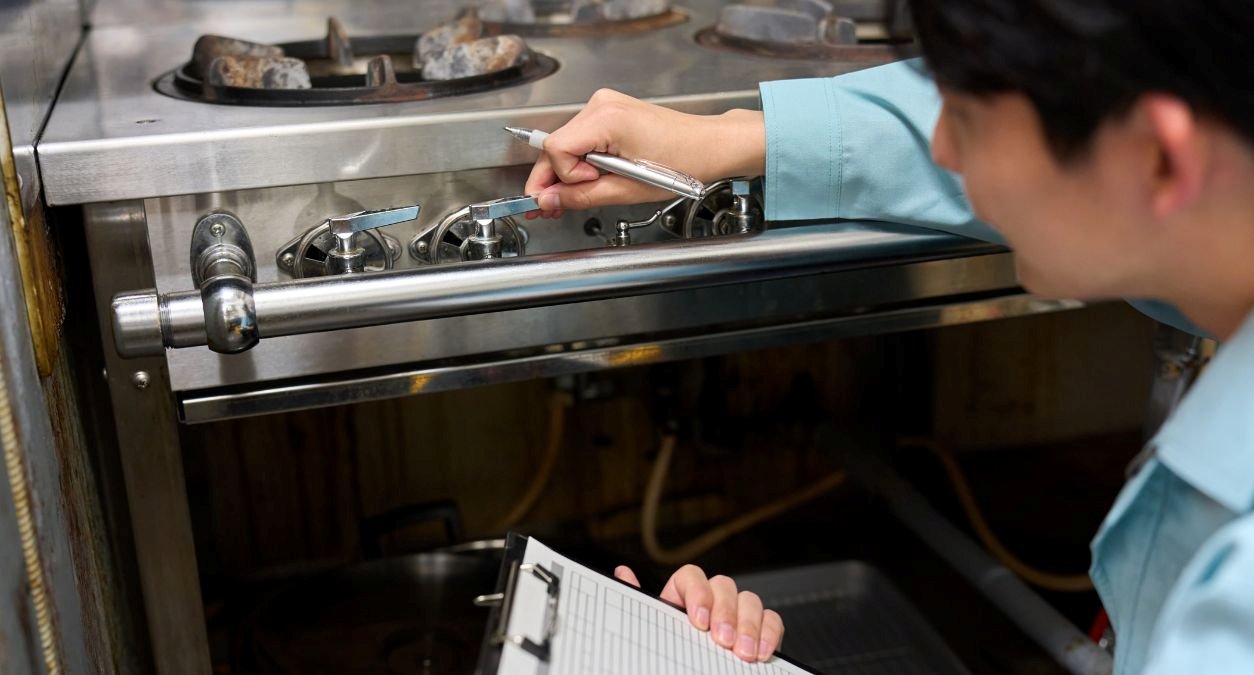
A catering gas inspection involves an assessment of your commercial gas installation and appliances to determine whether they are safe, properly maintained and operating as intended.
The engineer will usually examine each gas appliance, checking that it is operating correctly and burning fuel safely. They may inspect pipework for leaks or deterioration, test gas pressures, assess ventilation and examine flue systems to ensure combustion gases are being safely removed.
Safety devices built into appliances should also be tested to confirm they operate correctly if a fault occurs. Where appropriate, the engineer may carry out gas tightness testing to identify leaks that are not immediately visible.
If any problems are found, the engineer should explain the work required to bring the installation back to a safe condition. Equipment considered unsafe may need to be switched off or disconnected until appropriate repairs have been completed.
Gas safety regulations catering businesses should know
Several pieces of UK legislation underpin gas safety regulations for catering businesses.
The Gas Safety (Installation and Use) Regulations 1998 place responsibilities on employers and business owners to ensure gas appliances, installations and pipework are maintained in a safe condition.
These requirements work alongside the Health and Safety at Work etc. Act 1974, which requires employers to protect employees and others who may be affected by their business activities from avoidable risks.
As part of meeting these responsibilities, catering businesses should complete suitable risk assessments to identify potential hazards and decide which control measures are needed. This could include reviewing the condition of gas equipment, ventilation, staff training and the procedures employees should follow if they suspect a leak.
Businesses should also ensure appliances are properly maintained, arrange inspections by appropriately qualified engineers, repair faults promptly and retain records of servicing and inspections.
Any gas work must be carried out by a Gas Safe registered engineer with the appropriate qualifications for the type of commercial catering equipment involved. For current requirements and guidance, businesses should refer directly to the HSE and Gas Safe Register.
Gas safety requirements for mobile caterers
The gas safety requirements for mobile caterers are broadly similar to those for fixed commercial kitchens, but there are additional factors to consider because equipment is regularly transported between locations.
Food trucks, trailers and converted catering vehicles commonly use liquefied petroleum gas, or LPG, rather than mains gas. Cylinders must be securely stored, properly connected and transported safely to minimise the risk of damage or leaks. Hoses, regulators and fittings should also be inspected regularly, as movement during transport can cause components to loosen or deteriorate.
Ventilation remains another important consideration. Even when working in a compact mobile kitchen, sufficient airflow is needed to help appliances burn correctly and prevent harmful gases from accumulating inside the unit.
Festivals, markets and organised events may require mobile caterers to provide evidence of a current gas safety inspection before they are permitted to trade. Keeping your documentation accessible can help prevent delays when arriving or setting up at a venue.
Because mobile catering equipment experiences regular movement and vibration, it may benefit from additional visual checks between formal inspections. Equipment should also be examined following any journey or incident that may have damaged its fittings or connections.
How often should commercial catering equipment be inspected?
Many catering businesses arrange a formal gas safety inspection every 12 months. However, the appropriate frequency may vary depending on how the equipment is used, its age and condition, the manufacturer’s guidance and the recommendations of your engineer.
Annual inspections should not replace routine servicing or day-to-day checks. Equipment that is used intensively may require more frequent maintenance, particularly if it operates for long hours or is regularly transported between locations.
Staff should be encouraged to report changes in appliance performance or signs of damage as soon as they appear. Developing a preventative maintenance schedule can help businesses plan servicing costs while reducing the likelihood of emergency repairs during busy trading periods.
Inspection and servicing records should be stored somewhere accessible. You may need to produce them for landlords, local authorities, environmental health officers or event organisers.
Signs your gas equipment may need attention
Even with regular servicing, it is important to recognise the warning signs that something may be wrong.
Changes in how an appliance performs, unusual smells or visible soot around burners could indicate that equipment requires attention. Yellow or orange flames rather than a consistent blue flame may suggest that an appliance is not burning fuel correctly, while pilot lights that repeatedly go out could point to an underlying fault.
You may also notice appliances taking longer to heat, consuming more gas than usual or producing inconsistent cooking results.
Staff should not attempt to repair gas appliances themselves. If an appliance appears damaged or is not operating correctly, stop using it and arrange for it to be assessed by a suitably qualified Gas Safe registered engineer.
If you suspect a gas leak, follow the appropriate emergency procedures for your premises or mobile unit and seek professional assistance immediately.
A simple gas safety checklist for caterers
Keeping on top of gas safety requirements does not need to be complicated. A few consistent measures can help catering businesses reduce risks and demonstrate a responsible approach to compliance:
- Arrange regular inspections with a Gas Safe registered engineer qualified for commercial catering equipment.
- Keep clear records of inspections, servicing and repairs.
- Train staff to recognise potential signs of faulty gas appliances.
- Address defects promptly and stop using equipment that may be unsafe.
Taking a proactive approach to catering gas safety can help protect employees, customers and the business itself while reducing the risk of unexpected breakdowns and disruption.
Get Caterers Insurance from Protectivity
*Disclaimer – This blog has been created as general information and should not be taken as advice. Make sure you have the correct level of insurance for your requirements and always review policy documentation. Information is factually accurate at the time of publishing but may have become out of date.
Last updated by