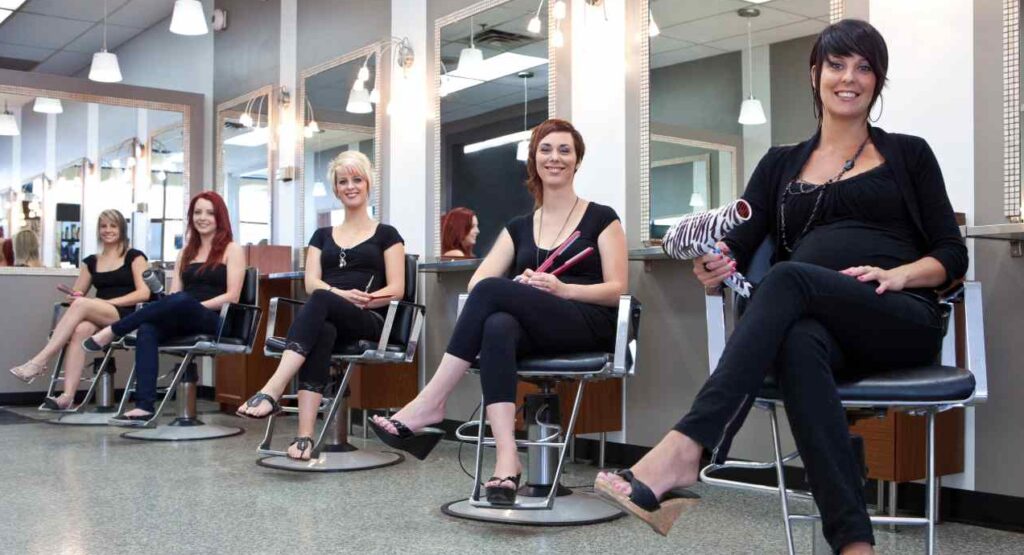



Salon Chair Rental: What to Consider

Table of contents

If you are one of the thousands of self-employed hairdressers or barbers in the UK then it is likely that you have considered renting a chair in a salon. This way of working can be mutually benefit for both the salon and you as a hairdresser.

But what does salon chair rental involve and what should you consider?


How do you rent a chair in a salon?

There are a few methods of renting a chair:

Fixed Rent

You can agree a fixed amount that you will pay the salon each week for renting a chair. This works in your favour if you succeed in getting lots of clients as the cost that you pay each week won’t increase as your earnings do.

Percentage of takings

You can also agree with the salon owner that you will pay them a percentage of your takings. While what you pay stays in line with what you take, Salon owners are often less keen on this method as their income decreases if you cut less hair.

A combination of both methods

Sometimes you can agree that you will pay a lower fixed rent as well as a percentage of the takings.


What are the hairdressing chair rental costs?

The average costs to rent a chair in a hair salon can vary between salons, so it is worth doing your homework to assess the average charges in your local area.

If you are paying a percentage of takings as a method of renting a chair, then you could expect to pay anywhere between 40-60%.


What are the benefits of renting a chair?

There are several benefits to renting a chair:

1. Cost – It is a fairly low-cost option for both parties. Salon owners don’t have the costs associated with permanent staff and for hairdressers it is a fairly straightforward way of managing outgoings.

2. Risk – There is less risk and commitment required for both the salon owner and hairdresser. You can enter into an agreement and if it doesn’t work out then you can terminate the arrangement.

3. Flexibility – In theory you can choose what hours you work. You can plan to work at key times of demand (evenings and weekends) in order to maximise your opportunity to earn.

4. Working in a Salon Environment – This can be beneficial for a number of reasons: Lots of clients prefer having their hair cut in a salon environment making you more appealing as a hairdresser, you can benefit from working around other hairdressers making it a more positive working environment with the opportunity to learn share skills and techniques.

What else should you consider before renting a chair?

If you are renting a chair, then you will need to work on a self-employed basis. This means that you will need to register for self-assessment and submit your income annually.

It is also unlikely that you will receive any employee benefits such as paid holiday, maternity leave, pension, healthcare etc.

Do you need a contract to rent a chair?

Yes, you should be sure to have a contract in place if you are renting a chair. A rent a chair contract will protect both you and the salon owner by ensuring that all details of your agreement are captured in writing and agreed by both parties.

If there isn’t one already available at the salon, there are plenty of templates available online. Be sure to capture all the important details: Price, length of agreement, working hours, ownership and payment for products and equipment that you will use when in the salon, as well as highlighting what happens if either party wants to end the agreement.

In summary, rent a chair hairdressing can be a low risk and flexible way of working. If you can build up a regular book of clients, then your potential to earn can be quite significant.

Protectivity is a specialist provider of Hairdressing Insurance. We cover thousands of individuals and small to medium size businesses including barber shop insurance across the UK, offering a range of tailored insurance products to protect our customers against unforeseen events.

Get Hairdressing Insurance from Protectivity


*Disclaimer – This blog has been created as general information and should not be taken as advice. Make sure you have the correct level of insurance for your requirements and always review policy documentation. Information is factually accurate at the time of publishing but may have become out of date. 

Recent Blogs

What is profit margin? Image

Business

What is profit margin?

For many small businesses, sales figures are the headline number. But revenue alone doesn’t determine succes

How to file company accounts online Image

Business

How to file company accounts online

Filing company accounts is one of those jobs that sounds more intimidating than it often is. If you run a small U

Incident insights in pet care: What 2025 claims data tells us Image

Pet Business

Incident insights in pet care: What 2025 claims data tells us

Caring for pets professionally is deeply rewarding, but it also comes with a unique mix of responsibility, unpred

Pros and cons of being VAT registered Image

Business

Pros and cons of being VAT registered

For many small business owners, VAT registration feels like a milestone. It often signals growth – but it can

Business website requirements: is having a website important? Image

Business

Business website requirements: is having a website important?

Most customers start their search for a product or service online. That’s why, for many small businesses, a web

What is PAYE? Image

Business

What is PAYE?

Taking on employees is a major step for any business, but it also brings new legal and financial responsibilities

How to register a business in the UK Image

Business

How to register a business in the UK

Essential steps for independent businesses Starting a business can combine freedom and ambition; the freedom

What is a Purchase Order? Image

Business

What is a Purchase Order?

Managing finances is one of the most demanding aspects of running a small business. As operations grow, so do the

What is the National Minimum Wage for employers Image

Business

What is the National Minimum Wage for employers

The National Minimum Wage plays a crucial role in protecting workers’ pay while shaping employment costs for bu

What is an SME? Small business status explained Image

Business

What is an SME? Small business status explained

If you run an independent business in the UK, whether you’re a freelancer, sole trader, or running a small, lim

Simply find the insurance you need.